0
Filling feed gaps: best practice hay and silage production
Home / Projects / Filling feed gaps: best practice hay and silage production
Filling feed gaps: best practice hay and silage production
Lead organisation: MacKillop Farm Management Group
Hub members and partners involved: Grassland Society of Southern Australia, Agriculture Kangaroo Island, Department of Primary Industries and Regions SA, Kangaroo Island Landscape Board, Fleurieu Farming Systems, Agricultural Innovation & Research Eyre Peninsula, Elders Rural Services Australia Limited
Project Category: Hub Projects
Project summary: 

This project is being conducted in the Limestone Coast, Fleurieu Peninsula, Kangaroo Island and Eyre Peninsula regions.

The project aims to improve primary producer decision making around the cost effective and sustainable production of hay and silage, and preparing for drought through best practice feed conservation and storage. The project will be conducted in the Limestone Coast (LC), Fleurieu Peninsula (FP), Kangaroo Island (KI) and Eyre Peninsula (EP) regions.

The project will do this by:

  • Conducting demonstrations of different methods of hay and silage production in the Limestone Coast, including innovative practices, as designed by MFMG and GSSA;
  • Conducting workshops with expert guest speakers aimed at increasing the skills of primary producers in best practice hay and silage production; and
  • Providing one-to-one support for producers to assist them in interpreting feed test results and planning for best practice hay and silage production.

Producing and providing resources (e.g. fact sheets, videos, podcasts) to primary producers outlining best practice methods for hay and silage production in each region.


Project description: 

The project enhances decision-making among primary producers regarding sustainable and cost-effective hay and silage production, across the Limestone Coast, Fleurieu Peninsula, Kangaroo Island, and Eyre Peninsula. Key activities include:

Feed Testing: Regional feed tests were conducted to gather data on hay and silage quality, establishing benchmarks for comparison over two years. This data helps producers understand production costs and improve their practices.

Workshops: The project organised workshops featuring expert speakers to educate producers on best practices for hay and silage production. Topics included calculating production costs, enhancing feed quality, and effective storage strategies. Workshops were tailored to local needs, incorporating regional data and practical components.

Feed Test Interpretation: Personalised support was provided to producers to help them interpret their feed test results. This included one-on-one discussions with specialists to offer tailored advice on improving production practices based on test findings.

Extension and Resources: Educational resources such as fact sheets, videos, and podcasts were developed and disseminated to support ongoing learning and application of best practices among producers in these regions. This comprehensive approach aims to foster a more resilient agricultural sector.

Demonstration Sites: Demonstrations sites were established, monitored and evaluated during the project. The demonstration sites allowed MFMG and GSSA local committee members (who are representatives of farmers in their region) to design demonstrations of hay and silage production, for the purpose of illustrating what methods work best in the Limestone Coast. The ideas to trial and potential host farm sites were driven by the local farmer committee members.


Project Background

This project had two main components: understanding the nutritional value of supplementary feeds for livestock, and best practice management of pasture/hay crops to make high quality hay and silage. Drought can severely impact pasture quality and availability, leading to nutritional deficiencies in livestock diets. By knowing the nutritional content of supplementary feeds, producers can make informed decisions to maintain animal health, productivity, and overall farm viability during these challenging conditions.

During drought, natural forage often becomes scarce or of poor quality. Supplementary feeds can bridge this gap, providing the necessary energy, protein, and micronutrients that livestock require. By assessing the nutritional value of various supplementary feeds, producers can select those that cost effectively fill their identified feed gap

In times of drought, efficient feed use becomes even more critical due to increased feed costs and limited resources. Knowing the nutritional value of supplementary feeds enables producers to maximise feed efficiency by selecting high-quality options that enhance livestock performance. For instance, energy-dense feeds can help maintain weight in livestock when pasture quality declines. By integrating supplementary feeds into the diet based on their nutritional value, producers can ensure that livestock maintain growth and reproduction even when faced with the constraints of drought.

Nutritional stress during critical periods, such as breeding and gestation, can lead to lower conception rates, increased foetal loss, and poor milk production in lactating females. By understanding the nutritional value of supplementary feeds, producers can implement strategies to support reproductive health during drought. For example, feed supplements with appropriate energy and protein can maintain stock at the right condition score for joining and during pregnancy. Accurate feed quality assessment for protein content is also important for weaner survival over summer.

Effectively utilising stored feed such as silage or hay and incorporating supplementary feeds such as pellets or grain requires strategic planning, especially in anticipation of drought. Producers who understand the nutritional composition of feeds can develop plans that balance the lower cost available feeds with the use of high-nutrient supplements when pasture conditions deteriorate. This allows for better resource allocation and ensures that livestock have access to necessary nutrients.

To manage pasture/hay mix for optimal hay or silage production, focus on timing, moisture content and cost per MJ ME. Producers must consider both the nutritional value and cost of different feed types. For instance, while wrapped silage may offer higher energy content, it can be expensive per unit of energy, making high-quality hay a more cost-effective option for many. Silage stored in pits or bunkers can be a cheaper long-term fodder conservation option. Investing in the knowledge of nutrition not only addresses immediate challenges posed by drought but also contributes to the long-term sustainability of livestock operations. With an understanding of how different feeds impact animal health and productivity, producers can build a more resilient system that stores surplus from a good year to use when the season is challenging. This resilience is crucial in an era of increasing climate variability, where droughts are likely to become more frequent and severe.

Key achievements and results: 

The work of the Filling Feed Gaps project across 4 high rainfall regions of South Australia has the following key findings:

Cost Efficiency: Assess hay or silage cost in terms of energy (MJ) rather than weight. Determine the cost per MJ by calculating the ME per tonne and dividing the price by it.

Pasture Management: Cut pasture early before maturity to avoid excess lignin, NDF, and nutrient loss. Wilt grass quickly, using tedding or mower/conditioners to speed up drying and prevent mould or bacterial growth.

Baling Strategy: If rain is expected, it’s better to bale slightly wetter and use preservatives than risk further weather damage. Hay preservatives help minimize spoilage by reducing air in bales. For difficult seasons, consider silage, which has a quicker curing time and lower weather risk.

Test for Quality: Regularly test both pasture and harvested fodder to ensure it meets livestock needs. Without testing, balancing diets accurately is difficult, as nutritional content varies. Poor-quality hay with high NDF (neutral detergent fiber) or low digestibility reduces intake and can lead to waste or refusal by livestock.

Silage vs Hay: Silage might be easier to produce in some regions (like Kangaroo Island) due to climate conditions, though hay is typically cheaper per tonne of dry matter. Both hay and silage tested similarly to the pasture’s quality at cutting in 2023, showing good practices in production. Choice between silage and hay may determined by availability of equipment and expected seasonal conditions

Benefits to Industry

The benefits to the industry from implementing the strategies discussed in the summary are significant, especially in terms of improving feed quality, cost efficiency, and overall productivity. By evaluating hay and silage based on energy content (MJ) rather than weight leads to more cost-effective feed management, reducing waste and improving livestock production. In the long term, this contributes to higher resilience and profitability. By increased producer understanding of feed quality, livestock can be fed more efficiently. This improves overall animal health and productivity. Producing high-quality feed that is palatable and digestible through optimised hay and silage practices reduces feed waste. Livestock are more likely to consume feed of high quality leading to less waste in terms of uneaten or discarded feed.  The use of techniques such as tedding, hay or silage preservatives, and considering silage as an alternative to hay during difficult weather conditions help reduce the risk of weather-related losses from an unpredictable climate. In years with poor hay drying conditions, silage may provide a reliable alternative that can safeguard feed quality and availability if equipment is available. Reducing waste, improving feed utilization, and making better use of available resources contribute to more sustainable farming practices, which is increasingly important to consumers and stakeholders.

Future adoption opportunities

Combining the Filling Feed Gaps work with the Containment feeding work and continuing to foster development in feed budgeting will allow producers to come through a season which continues to challenge many.

Filling Feed Gap Case Study 

A case study on the project can be viewed here.
A full final technical report will be released in early 2026.

Further information:

Project Images

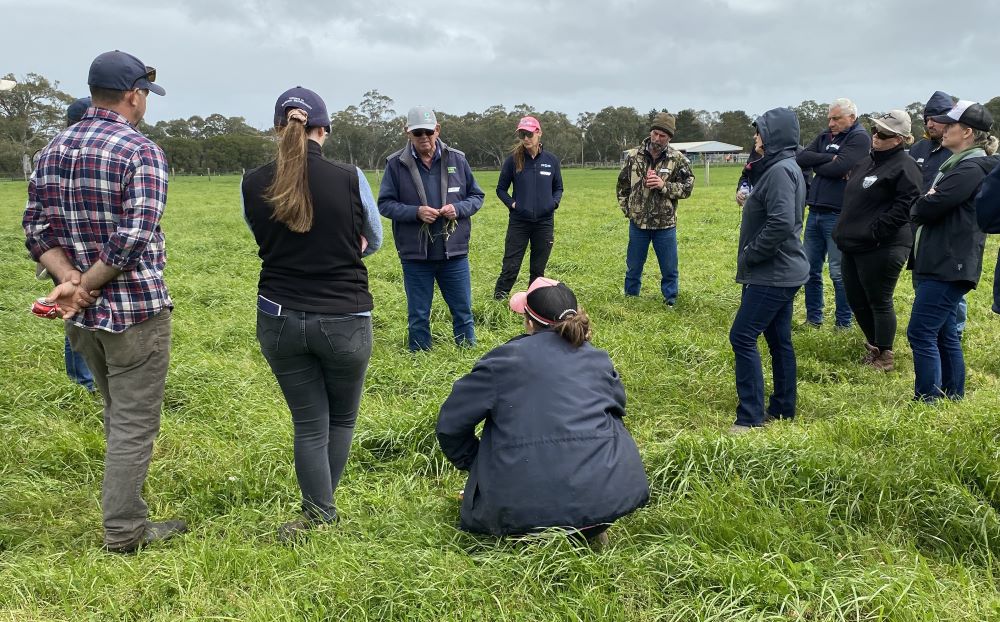
Tim Prance speaks to Fleurieu Peninsula producers about cost-effective and sustainable production of hay and silage.
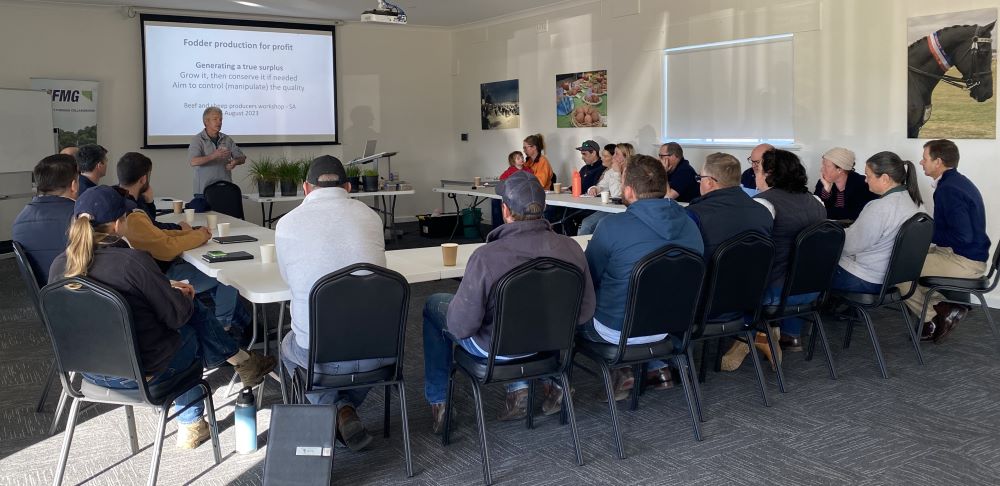
 

Phil Shannon presents at a Naracoorte workshop on profitable fodder production.